
Carbon footprint calculator
Turn your footprint into protected rainforest
See your yearly carbon footprint in two minutes, then offset it by restoring elephant habitat in Sumatra.
Calculate my footprintFilled in with typical U.S. values. Change anything that doesn’t fit you.
Type of car
Which diet is closest to yours?
Shopping and other spending: we add the U.S. average, about 3 tons.
0.0 tons CO₂ a year
Offset it for $0.00 a year
Your yearly footprint
0.0 tons CO₂
Opens our secure donation form with your amount filled in.
- 100% of your gift goes to conservation
- Tax-deductible · 501(c)(3) nonprofit
- EPA 2025 emission factors · see our method

3,651 of 3,773 acres secured in the Lokop elephant corridor. 122 acres to go.
What your gift protects
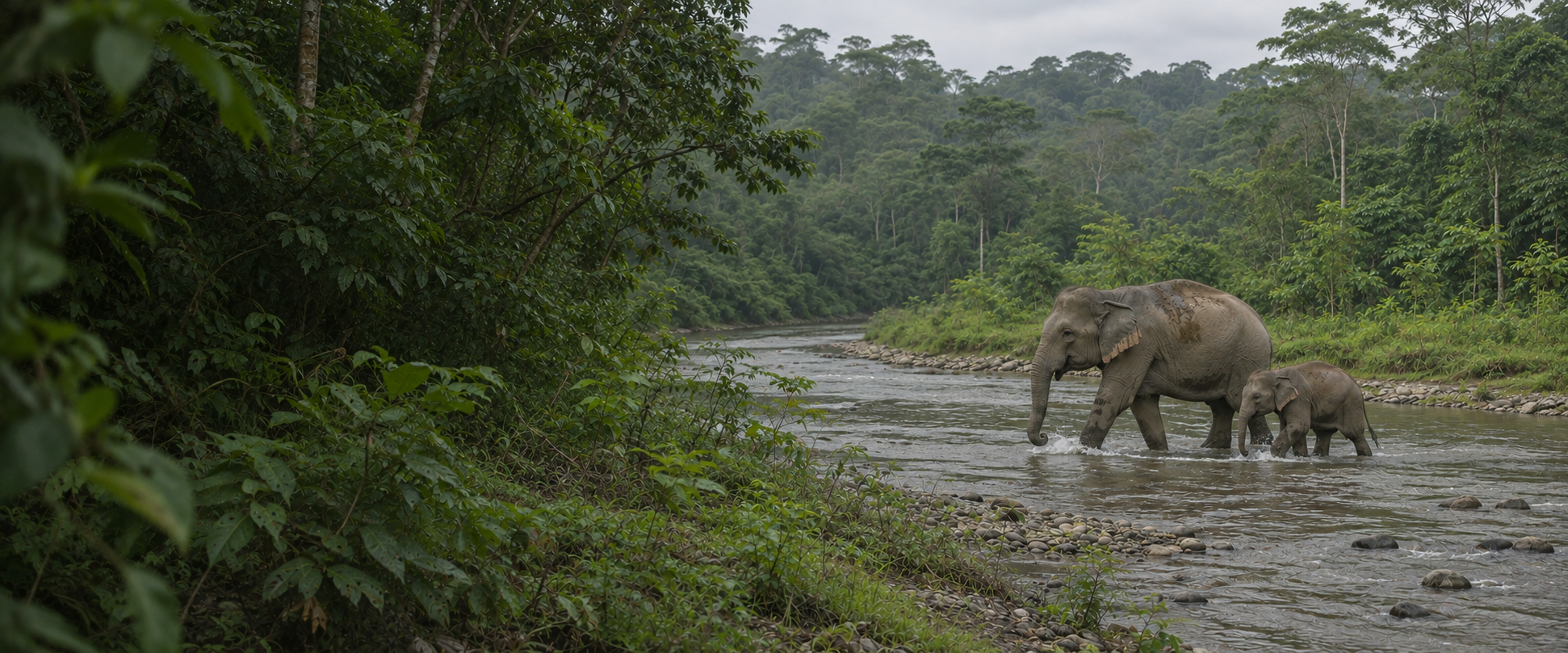
Give Sumatra’s elephants a way home
Oil palm, roads and mines are cutting Leuser’s rainforest into islands. As their routes close, elephants are forced through plantations, farms and villages, where they are persecuted, electrocuted and poisoned.
We are creating a river corridor so they can move safely between protected areas, along with Sumatran rhinos, tigers and orangutans. The Lokop Corridor’s 3,773 acres reconnect a 13,600-acre elephant range to the 740,000-acre Leuser Ecosystem.
We have secured 3,651 acres. Your gift helps buy the last 122. Once secured, the land is never cleared again. It regrows on its own, guarded by rangers from our partner the Leuser Conservation Forum, who have removed more than 5,000 snares across Leuser since 2014.

- protects one tree’s worth of forest
- $1.50
- of CO₂ captured per acre, per year
- 4.9 tons
- of carbon capture counted per acre
- 40 years
- per ton of CO₂ offset
- $5.21
About your footprint
Understanding Your Carbon Footprint: Calculate & Take Action
We all produce carbon dioxide (CO2), directly or indirectly, when we use products produced using fossil fuels. For example, we directly produce carbon dioxide when we drive a car or take a flight. We also indirectly produce carbon dioxide when we eat food that has been produced with artificial fertilizers and pesticides (which are made from oil). In total, the amount of carbon dioxide you produce is your “carbon footprint.”
Wondering how your impact compares? Our comprehensive carbon footprint calculator allows you to accurately estimate your carbon emissions and clearly understand the number of trees needed to offset your carbon footprint. Forget complex calculations – our carbon footprint to trees calculator makes it easy to see the direct link between your emissions and the power of reforestation. In just a few minutes, you can calculate your carbon emissions and learn exactly how many trees it takes to offset them effectively.

Your Food Footprint: How Your Diet Impacts Carbon Emissions
Your dietary choices are a significant factor in your carbon footprint. Foods like meat (especially beef and lamb) and dairy generally produce higher emissions compared to plant-based options. Our detailed carbon calculator helps you measure the environmental impact of your diet by considering:
- Reducing Meat Consumption: Lowering red meat intake significantly reduces CO2 emissions from beef production.
- Choosing Plant-Based Alternatives: Opting for beans, lentils, or tofu can substantially cut your carbon emissions.
- Supporting Local and Seasonal Foods: Choosing locally grown and seasonal produce minimizes transportation emissions, reducing your overall footprint.
- Minimizing Food Waste: Buying only what you need and composting food scraps helps lower emissions associated with waste.

Your Home’s Carbon Footprint: Simple Ways To Reduce Emissions
Your energy consumption at home plays a crucial role in your overall CO2 emissions. Our CO2 calculator helps you identify and implement effective strategies to lower your household carbon footprint. Here are practical tips for a more sustainable home:
- Investing in Energy-Efficient Appliances: Upgrading to energy-efficient models can lead to significant electricity savings and a smaller footprint.
- Switching to Sustainable LED Lighting: LED bulbs consume far less energy and last longer than traditional options.
- Optimizing Your Thermostat Settings: Adjusting your thermostat a few degrees can significantly reduce energy use for heating and cooling.
- Eliminating Phantom Energy Consumption: Unplugging electronics when not in use prevents unnecessary energy waste.

Your Transportation Carbon Footprint: Making Greener Travel Choices
The distance and mode of your travel have a substantial impact on your CO2 emissions. Use our intuitive carbon footprint calculator to understand the environmental consequences of your transportation choices. Consider these impactful adjustments to your travel habits:
- Carpooling and Sharing Rides: Reducing the number of vehicles on the road lowers overall emissions.
- Utilizing Public Transportation: Opting for buses or trains is a more carbon-efficient way to travel.
- Choosing Active Transportation: Biking or walking for short trips eliminates emissions entirely and offers health benefits.

Offset Your Carbon Footprint Now: Protect Forests For A Sustainable Future
By directly supporting Saving Nature’s work to protect and restore forest in Sumatra, you contribute to a healthier planet for future generations. Protecting land and letting the forest regrow naturally is one of the most effective ways to offset your carbon footprint. Trees absorb CO2, making forests vital in the fight against global warming. Here’s why protecting forests is crucial:
- Absorb and Store Carbon: Trees capture and store substantial amounts of carbon dioxide throughout their lifespan, directly reducing atmospheric CO2 levels.
- Create and Restore Habitats: Protected, regrowing forest restores crucial habitat for elephants, tigers and countless other species, promoting biodiversity.
- Filter and Improve Air Quality: Trees act as natural filters, absorbing pollutants and significantly enhancing the air quality we breathe.
- Foster Positive Community Benefits: Forest protection projects often involve local communities and keep valuable green spaces intact.
Questions
Frequently asked questions
How does this carbon footprint calculator work?
It adds up the carbon dioxide from your home energy, travel and food, using the U.S. EPA’s 2025 emission factors. We fill in typical U.S. values to start, so you can change anything that doesn’t fit you. Your result shows your yearly footprint in tons of carbon dioxide.
How much does it cost to offset my carbon footprint?
About $5.21 per ton of carbon dioxide. The average American produces roughly 14 tons a year, so offsetting a typical footprint costs about $73 a year.
How do you get $5.21 a ton?
Restored rainforest captures about 4.9 tons of carbon dioxide per acre each year. Buying and restoring an acre costs about $1,010, or about $1.50 per tree. We spread that cost over 40 years of carbon capture, which works out to about $5.21 per ton.
Where does my gift go?
To the Lokop Corridor in Sumatra’s Leuser Ecosystem. We have secured 3,651 of the corridor’s 3,773 acres, and your gift helps buy the last 122. Once we fund the purchase of the land, nobody clears it again; it regrows on its own, guarded by rangers from our partner, the Leuser Conservation Forum.
Is this a certified carbon offset?
No. Your gift is a tax-deductible donation that restores rainforest; it does not buy a certified carbon credit. The calculator shows how much forest it takes to balance your footprint.
Does offsetting replace cutting my emissions?
No. Cut what you can first: drive and fly less, save energy at home and eat less red meat. Then offset the rest.
Is my gift tax-deductible?
Yes. Saving Nature is a 501(c)(3) nonprofit, and gifts are tax-deductible as allowed by law. 100% of your gift goes to conservation; operating grants cover our overhead.
Assumptions and sources
- Home energy, vehicle and flight emissions: U.S. EPA GHG Emission Factors Hub (2025) and eGRID2023. Energy prices: U.S. Energy Information Administration.
- Gasoline cars 8,887 g CO₂ per gallon; hybrids 180 g per mile; battery-electric cars 136 g per mile; flights 164 g per passenger-mile, doubled for the extra warming effect of emissions released at altitude (radiative forcing).
- Food: Shrink That Footprint and Our World in Data, based on 2,600 calories a day. Shopping and other spending use a U.S. average of 3 tons.
- Offsets: restored and protected forest captures about 4.9 tons of CO₂ per acre per year, with about 675 trees per acre. Land and restoration cost about $1,010 per acre, or about $1.50 per tree, spread over 40 years of carbon capture: about $5.21 per ton of CO₂. Results are in U.S. tons. Actual costs and growth rates vary by project.
More free calculators: Flight Carbon Calculator · AI Carbon Footprint Calculator
Saving Nature, Inc. is a nonprofit corporation granted tax-exempt status with the IRS as a 501(c)(3) organization. As a nonprofit 501(c)(3) organization, donations to Saving Nature are tax-exempt and qualify as a charitable deduction for federal income tax purposes. Saving Nature complies with all 501(c)(3) rules and regulations.